 My Tijarah
The Road toFluency inArabic
Why the language of the Qur’an iscloser than you have been told.
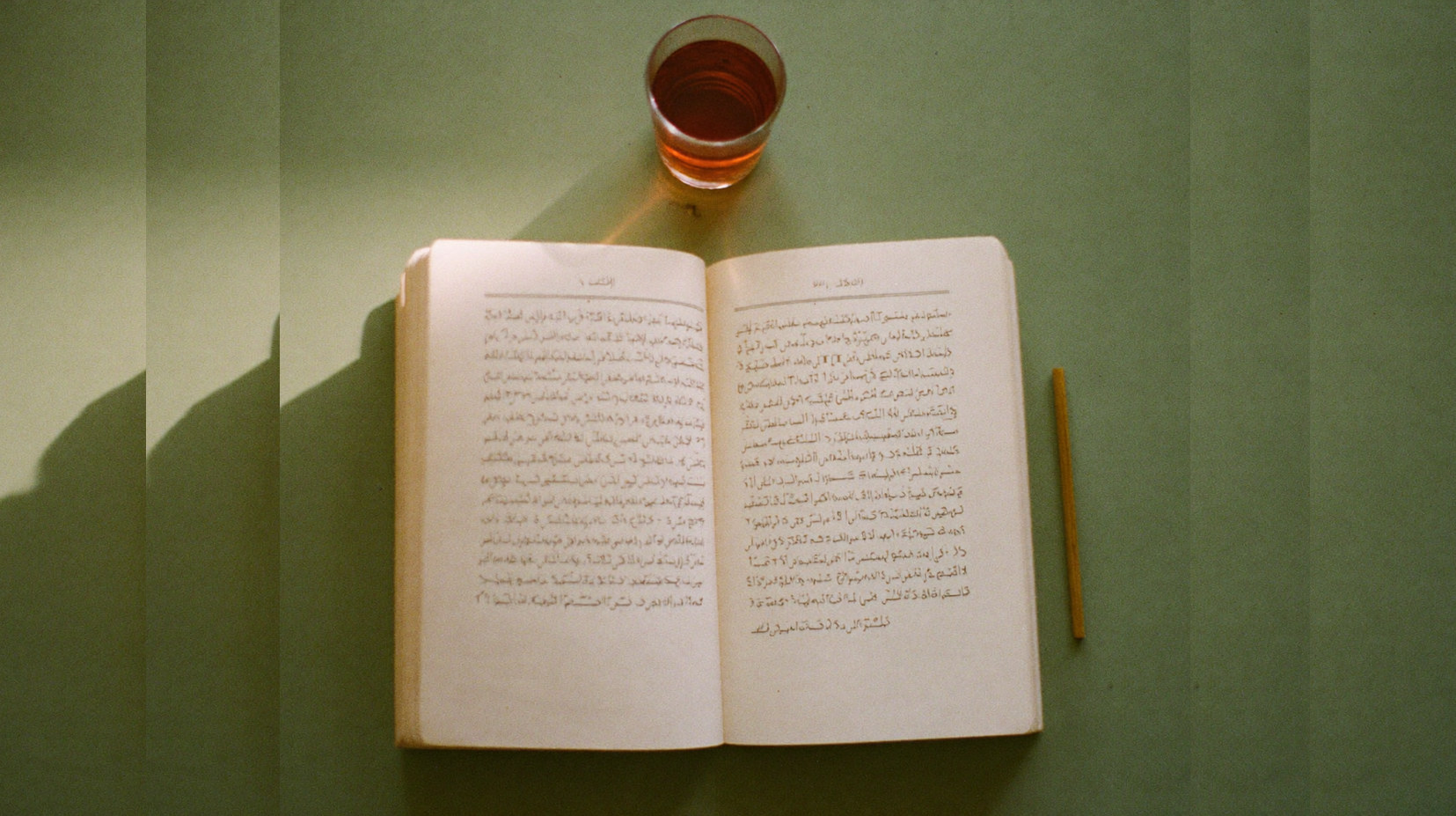
What is inside
Contents
Why it is worth it
- You already know some ArabicAnd a 10-minute start for tonight
- What a translation cannot give youThe Qur’an, ash-Shafi’i and Ibn Taymiyyah
- The tailor who could not sewIbn Khaldun on why rules are not enough
Why it is learnable
- A hundred words, half the Qur’anCounted from the corpus
- One root, a whole familyHow Arabic multiplies what you learn
- The verb, in ten shapesOne table that explains thousands of verbs
- Eight ideas that open sentencesThe grammar worth meeting early
- One line, taken apartFour words you may already say
The six steps
- Six steps, and no stopwatchWhat changes in you, in order
- What each step coversFrom the letters to the classical books
How to keep going
- The daily habitFour parts of whatever time you have
- How to stop forgettingThe one thing that makes words stay
- Read every dayEasy texts, read for meaning
- What stops peopleFive things, and the fix for each
- Honest answersIncluding how long this takes
- What a book can’t doAnd what to bring to a teacher
The Fluency Workbook goes with this guide: eight sheets to print and fill in as you read. Each sheet names the page here that it belongs to.
Where you are starting from
You already know some Arabic.
You say these every day. Nobody sat you down to learn them.
بِسْمِ اللَّه
bismillah
in the name of Allah
الْحَمْدُ لِلَّه
alhamdulillah
all praise is for Allah
اللَّهُ أَكْبَر
Allahu akbar
Allah is greater
سُبْحَانَ اللَّه
subhanallah
how perfect Allah is
السَّلَامُ عَلَيْكُم
as-salamu alaykum
peace be upon you
كِتَاب
kitab
a book
عِلْم
‘ilm
knowledge
صَبْر
sabr
patience
Pull apart the one you say most. You’ll meet its four pieces on almost every page of Arabic.
That’s a definite article, a preposition, a three-letter root and a case ending. You use all four correctly in prayer without knowing their names. You’re not starting from zero.
Why it is worth it
A translation is somebody else’s understanding, handed to you.
Read the Qur’an in English for thirty years and you’ll know it well. What you’ll know is a translator’s reading of it: his words, his choice of which of three senses a verb has in this place, his best try at a word English has no twin for. He’s usually a careful scholar who did honest work. He’s still standing between you and the words of your Lord.
إِنَّآ أَنزَلْنَـٰهُ قُرْءَٰنًا عَرَبِيًّا لَّعَلَّكُمْ تَعْقِلُونَ
Indeed, We have sent it down as an Arabic Qur’an that you might understand.
Yusuf 12:2
بِلِسَانٍ عَرَبِىٍّ مُّبِينٍ
In a clear Arabic language.
ash-Shu’ara 26:195
فعلى كل مسلم أن يتعلم من لسان العرب ما بلغه جهده
It is a duty upon every Muslim to learn of the tongue of the Arabs as much as he is able.
فإن نفس اللغة العربية من الدين، ومعرفتها فرض واجب
The Arabic language is itself part of the religion, and knowing it is an obligation.
Why rules are not enough
The tailor who could not sew.
Over six hundred years ago Ibn Khaldun asked why the best grammarians he knew couldn’t write a decent letter to a friend. His answer explains most of what goes wrong for learners today. A language, he said, is a malakah: a habit the tongue picks up, closer to a craft in the hands than to anything you could sit an exam in.
فإن صناعة العربية إنما هي معرفة قوانين هذه الملكة ومقاييسها خاصة، فهو علم بكيفية لا نفس كيفية
The craft of grammar is only the knowledge of the rules of this faculty and its measures. It is knowledge of a how, not the how itself.
His example is a tailor. A man can describe stitching to you in perfect detail: the thread through the eye of the needle, in through both edges of the cloth, out the far side, back round to where he began. Hand him the needle and he can’t sew a stitch. Knowing grammar without the habit is the same.
That sounds discouraging until you turn it round. A subject asks you to be clever. A habit asks something easier: that you keep showing up. You’ve built habits all your life. Ibn Khaldun says exactly what builds this one.
حصول ملكة اللسان العربي إنما هو بكثرة الحفظ من كلام العرب، حتى يرتسم في خياله المنوال الذي نسجوا عليه تراكيبهم فينسج هو عليه
The faculty of the Arabic tongue is obtained only through much memorising of the speech of the Arabs, until the loom upon which they wove their constructions is imprinted in his imagination, so that he weaves upon it too.
Fill yourself with real Arabic until the pattern is printed on you. Then use it. For you, the real Arabic starts with what you already say: Al-Fatiha, the short surahs and the words of your salah.
Why it is learnable
A hundred words make up over half the Qur’an.
Some words work much harder than others. That’s true of every language, and even more so in the Qur’an. Count every word in the Book, rank them by how often they turn up, and you get this shape.
25%
from 10 words
About a quarter of the words on a typical page.
58%
from 100 words
More than half, from one sheet of vocabulary.
85%
from 670 words
Eighty five in every hundred words.
Ten words fit in one evening. A hundred fit on one sheet you could keep in your wallet, and they make up more than half the words on a typical page. That isn’t half the meaning: the rarer words carry a lot of it. It does mean the first words you learn turn up every time you open the mushaf. So learn them first, and review them often.
Why it is learnable
Learn one root and you have learned a family.
Behind most Arabic words sit three letters holding one idea. Change the shape around them and you change what’s being done with the idea. The idea stays put. Take the root for knowing.
Three letters
ع ل م
The idea of knowing
عَلِمَ
he knew
عَلَّمَ
he taught
تَعَلَّمَ
he learned
اِسْتَعْلَمَ
he enquired
عِلْم
knowledge
عَالِم
a scholar
مَعْلُوم
known
تَعْلِيم
teaching
مُعَلِّم
a teacher
عَلِيم
all-knowing
Knowing, teaching, learning, a scholar, a teacher, knowledge itself. Ten dictionary entries with one idea under them. You won’t learn these one at a time. You’ll start to recognise them, and recognising takes far less work than memorising.
Each root you learn properly brings a family with it. That’s why the early roots feel slow and the later ones come faster. A new word from a family you know is already half learned. So start with the roots you meet most often.
And the shape around it carries meaning too
فَاعِل
the one doing it
كَاتِب
a writer
مَفْعَل
the place it happens
مَكْتَب
a desk, an office
مِفْعَال
the thing it is done with
مِفْتَاح
a key
Why it is learnable
Ten shapes, and thousands of words.
Pour a root into one of ten moulds and the meaning bends in a way you can predict: made to happen, done with someone else, done to yourself, asked for. The root keeps its idea all the way through.
| Shape | Pattern | What the shape adds | Example | Meaning |
|---|---|---|---|---|
| I | فَعَلَfa’ala | The bare meaning of the root | عَلِمَ’alima | he knew |
| II | فَعَّلَfa’’ala | Made to happen, or done intensely | عَلَّمَ’allama | he taught |
| III | فَاعَلَfā’ala | Done to or with another party | جَاهَدَjāhada | he strove against |
| IV | أَفْعَلَaf’ala | Caused to happen | أَنْزَلَanzala | he sent down |
| V | تَفَعَّلَtafa’’ala | Shape II, turned back on the doer | تَعَلَّمَta’allama | he learned |
| VI | تَفَاعَلَtafā’ala | Done to one another | تَعَاوَنَta’āwana | he cooperated |
| VII | اِنْفَعَلَinfa’ala | It happened, with no doer named | اِنْشَقَّinshaqqa | it split apart |
| VIII | اِفْتَعَلَifta’ala | Done for oneself, or with effort | اِسْتَمَعَistama’a | he listened |
| IX | اِفْعَلَّif’alla | Colours, and little else | اِسْوَدَّiswadda | it turned black |
| X | اِسْتَفْعَلَistaf’ala | Seeking or asking for the meaning | اِسْتَغْفَرَistaghfara | he sought forgiveness |
Read down the third column, not across. Once a doubled middle letter starts to feel like cause, and the ista- on the front like asking, you’ll meet verbs you’ve never seen and understand them anyway.
Not every root comes in every shape, and some shapes are rare. Shape IX is used for colours and little else. Learn the ten patterns once, then let your reading show you which roots use which. The table is printed again in the workbook, ready for the wall.
Why it is learnable
Eight ideas that open almost any sentence.
Arabic grammar is huge, and you’ll use a fraction of it. These eight do most of the work. Almost everything you meet later builds on one of them.
Most Arabic words are built on three letters. Learn the root and a whole family comes with it.
The letters and vowels around a root carry meaning of their own: the doer, the place, the tool, the asking.
Noun, verb, particle. Most of grammar follows from this one question, so ask it of every word you meet.
A subject and what is said about it, with no verb between. Arabic needs no word for "is" here. It feels odd for a week, then natural.
Two nouns joined together: the book of the student. You’ll meet it all the time.
On a noun they mean my, your, his. On a verb, me, you, him. You’ll find them on almost every line of the Qur’an.
English uses word order to show who did what to whom. Arabic puts it in the endings, so it can move words around and stay clear.
The last one is no rule at all. Read enough and the right sense of a hard line arrives on its own, and you won’t be able to say which rule gave it to you.
Don’t try to master all eight before you read anything. Turn the page to see most of them at work in one short line from the Qur’an.
Why it is learnable
Four words, and most of the eight ideas.
Here’s a line from the Qur’an you may already say in your du‘a. It comes at the end of Ta-Ha 20:114, where the Prophet ﷺ is told to ask his Lord for more knowledge.
وَقُل رَّبِّ زِدْنِي عِلْمًا
“And say: My Lord, increase me in knowledge.”
Surah Ta-Ha · 20:114
Take it apart word by word, as step two of the six asks you to.
The six steps
Six steps, and no stopwatch.
Six steps, in the order they’re best taken. There are no hours or levels pinned to them, on purpose. People move at speeds no book can guess, and a schedule you fall behind gives you a reason to stop. Each step says what changes in you. None has a date.
- Step 1The sound and the script
The letters stop being a puzzle and become something you read.
- Step 2Your first sentences
You read a simple line and can say why it means what it means.
- Step 3The verb, and the shape of words
The Qur’an begins arriving as sentences rather than sounds.
- Step 4The endings
The endings make sense, and the vowel marks come off.
- Step 5Reading on your own
You pick up Arabic books for what is in them.
- Step 6The language becomes yours
The language stops being something you study and becomes yours.
The six steps
What the first three steps cover.
The sound and the script
The letters stop being a puzzle and become something you read.
You open the mushaf somewhere you have never read, and take a line aloud at a steady pace without stopping to work out a letter.
Your first sentences
You read a simple line and can say why it means what it means.
You take a short ayah apart word by word and can account for every piece of it, prefixes and all.
The verb, and the shape of words
The Qur’an begins arriving as sentences rather than sounds.
You meet an unfamiliar word, find its root and its shape, and land on the meaning more often than you miss.
The six steps
And what the last three ask of you.
The endings
The endings make sense, and the vowel marks come off.
You read a paragraph of unvowelled prose aloud and put the right ending on each word as it comes.
Reading on your own
You pick up Arabic books for what is in them.
You finish a whole Arabic book for what it says, then reach for another one.
The language becomes yours
The language stops being something you study and becomes yours.
There is no test to pass here. You have stopped studying Arabic and started reading in it.
You don’t have to aim for step six. If your goal is your salah and the Qur’an you pray with, most of that work happens in steps one to four. Go as far as your goal needs.
How to keep going
What a day of Arabic looks like.
Twenty minutes today and twenty tomorrow will take you further than three hours on a Sunday. Ibn Khaldun said as much six centuries ago: the habit forms through repeated action, one day after another, and comes apart when the days stop. Whatever time you have, split it roughly like this.
ReviewA quarter
Whatever is due from before, and nothing more. It goes first because it’s the part you’ll want to skip on a tired evening.
StudyA third
Whatever you’re working through, with your teacher or on your own. One thing understood properly does more than three skimmed.
ReadA quarter
Something a little below your level, read for meaning with the dictionary shut. Most of your Arabic gets built here.
Say itThe rest
A few sentences of your own, out loud, from what you studied today. Alone is fine. A mistake said out loud is one someone can correct.
The circle shows an hour because it’s easy to read. Twenty minutes on a weeknight works the same way: five to review, seven to study, five to read and three to say it.
If two of the four is all you can manage, make them review and reading. If ten minutes is all you have, take the ten minutes. You’ll miss days. Everyone does. Pick it up the next morning without trying to make up the lost time, and try not to let a second day go by.
It helps to fix the time. Tie the session to something you already do every day, like a prayer you never miss, so you don’t have to decide each evening when to start. The same time every day takes one decision off your plate.
How to keep going
Everything leaks, and there is a simple way to stop it.
Meet a word once and it’s likely gone within a week. That’s how memory works, for everyone. Trying harder on the day you meet a word does little. Coming back to it four or five times, at widening gaps, does most of the work.
Each dot is a review. It lifts you back to the top and flattens the slope on the way down. By the fifth, the line has almost stopped falling.
Same day
Before you sleep, while the shape is still fresh.
The next day
The drop is steepest in the first day.
Three days later
It takes some effort to recall it now. That effort is the learning.
A week later
Words that survive a week tend to survive.
Three weeks later
By now it’s settling in.
A couple of months later
From here, bumping into it while reading does the job.
How to keep going
Read every day, and read easy things.
Read Arabic every day at a level where you follow nearly all of it. Read it the way you read English, for what it says, not for the grammar inside it. Of everything in this guide, this habit does the most work.
Picking a text is easier than it sounds. If you stop more than a couple of times in a hundred words, it’s too hard, and you’ve spent the evening looking things up. Go down a level. If you never stop at all, go up one.
Roughly the order it gets easier in
- The Qur’an you already knowFrom the start
Short, familiar, half memorised already. You know what these say before you can read them, which makes them the gentlest start.
- Graded stories written for learnersEarly
Books that start very simple and get harder page by page. Any decent one will do. Read it for the story.
- Longer narrative, still gradedMiddle
History, the lives of the Companions, adab. Real paragraphs, written with a learner in mind.
- Hadith collectionsMiddle
Good reading at this stage, because each one ends before you tire of it.
- Plain modern tafsirLater
Clear, plain Arabic across the whole Qur’an. This is the one that shows you that you can read.
- Classical commentary, and the poetsLater still
Nothing simplified, nothing abridged. The shelf you always meant to get to.
Not sure where to begin? Take the first rung: a short surah you know by heart. Read it slowly with a word-by-word translation beside it, and count the words you now know from this book. Then read it again tomorrow. The second time is easier, and that’s the point. Move to the next surah only when the first one reads easily.
How to keep going
Five things that stop people, and none of them is ability.
If you’ve started Arabic before and stopped, read this page first. You didn’t fail. Most likely you hit one of these five, and each one can be seen coming.
Collecting instead of finishing
Nine courses started and none finished. Ibn Khaldun gave a chapter to this one: too many books on a subject get in the way of learning it.
Instead: One thing at a time, front to back, before you start another.
Grammar with no Arabic in it
Years of rules and not one book read. Knowing how a thing is done isn’t the same as doing it.
Instead: Match every hour of grammar with an hour of reading.
Never saying anything out loud
You follow a lot, then freeze the moment someone asks you to say something. Listening and reading build understanding. Only speaking builds speech.
Instead: Say it or write it the same day you meet it. A few minutes is enough.
Studying in bursts
A big weekend, then three weeks of nothing. The habit forms through repeated action on days that follow each other, Ibn Khaldun wrote, and it fades when the days stop.
Instead: Little and often. Try not to let two days go by.
Learning entirely alone
You can’t hear your own accent, or catch the mistakes you don’t know you’re making. And you can’t tell a page you understood from a page you only felt you understood.
Instead: Someone who hears you read and speak, even once a week.
Honest answers
Including the one you most want answered.
How long will it take?
We’d rather tell you why we won’t answer than make up a number. People move at speeds no book can guess: the hours they have, the teacher they find, how much Arabic was in their ear as a child. Put a date on it, and the day you fall behind becomes the day you think about stopping. Here’s what we can say. Understanding the words of your own salah is a far smaller goal than fluency, and a good first one.
Which course or book should I use?
We’ve named none, on purpose. What suits you depends on where you live, what you can spend and who’s teaching you. An ordinary book with a good teacher will do more for you than a famous book on your own. Show this guide to a teacher you trust, tell them where you’ve got to, and choose together.
Am I too old to start?
No. Adults learn a language differently from children, and people mistake that for learning it worse. You have patience, you spot patterns, and you know what grammar is for. What a child has over you is no embarrassment at all, and you can borrow that today.
Should I learn a dialect too?
Only if you have a reason to. If you came for the Qur’an, the Sunnah and the books of the scholars, fusha is the target and a dialect is a detour. If you also want to talk with people in Cairo or Riyadh, add one once your fusha is solid.
Is memorising Qur’an enough to learn Arabic?
It’s a good start. On its own, it won’t finish the job. Memorising without understanding trains your recall and leaves your understanding where it was. Learn what the words mean as you memorise them, and the Qur’an becomes the centre of your study instead of something running beside it.
Sources and method
Where everything here came from.
Every figure and quotation here traces back to something you can check.
Ibn Khaldun
- Al-Muqaddimah, book six: that language is a craft habit you acquire; that the habit of the tongue is not the same as the craft of grammar; that it comes from memorising a lot of real Arabic; and that tool subjects should be studied only as far as they serve the goal.
- Also his chapters on too many books getting in the way of learning, on not letting long gaps fall between sittings, and on travelling to sit with teachers.
- Text as printed in Tarikh Ibn Khaldun, volume one. Renderings here are our own.
The rulings
- Imam ash-Shafi’i, ar-Risalah, on the duty of every Muslim to learn of the tongue of the Arabs as much as he is able.
- Ibn Taymiyyah, Iqtida as-Sirat al-Mustaqim: Arabic is the emblem of Islam and its people, and knowing it is an obligation because understanding the Book and the Sunnah depends on it.
- On the attribution to ‘Umar: we could not confirm a chain for the wording “Learn Arabic, for it is part of your religion”, so the book does not quote it as his. The letter to Abu Musa al-Ash‘ari is recorded in Musannaf Ibn Abi Shaybah.
The Qur’an word counts
- Computed from the Quranic Arabic Corpus morphology, ranking every word in the Qur’an by how often it appears, then accumulating the share of the Book covered.
- A word counts as covered only when every stem inside it is known. Prefixes and suffixes are excluded from the ranking.
The review ladder
- Cepeda, Pashler, Vul, Wixted and Rohrer (2006), a review of 317 experiments on spaced practice, and the finding that the useful gap widens the longer you want to keep something.
- The forgetting curve has been measured since the 1880s. The figure on that page is a sketch, not a plot of your memory.
On naming no materials
- This guide recommends no course, no syllabus and no titles, which is deliberate. The right material depends on where you live, what you can afford and who is teaching you, and it is a decision to make with a teacher rather than with a book.
- The order of the six steps follows the sequence common to the classical Arabic sciences: sound and script, then the sentence, then the verb and its patterns, then the endings, then reading at length, then rhetoric.
On promising no timescales
- Earlier drafts of this guide gave an hour count for each step. We removed it. Learners move at very different speeds for reasons no book can see, and a timetable that turns out wrong becomes a reason to give up.
- For the same reason the guide promises no fluency. The title names the road, not a date at the end of it.
The ayat
- Yusuf 12:2, ash-Shu’ara 26:195 and the end of Ta-Ha 20:114. The Arabic follows the Uthmani script; the English is Saheeh International. Check any ayah on quran.com.
- The English gives the meaning. It does not replace the Arabic in worship or in study.
Transliteration
- Arabic words are also spelled in English letters to help you say them. The spelling is a guide to the sound, not a strict system.
Keep this guide
Print it, write on it, and pass it to someone who has been meaning to start. If you find a mistake in it, tell us and we’ll fix it. You’re welcome to copy any page for your own study.
What this book can’t do
A book can’t hear you read.
You now have the order, the habit and your first words. What no book can do is tell you when a letter comes from the wrong place in your mouth, or whether the line you think you understood is the line you did.
Your ear
You can’t hear your own accent. A letter made in the wrong place sounds right to you, sometimes for years, until someone kindly says so.
Your mistakes
The mistakes that cost you most are the ones you don’t know are mistakes. You can’t look those up.
Your pace
Someone listening can tell you whether a page was really understood, and when to move on.
Ibn Khaldun wrote that what you take from a teacher face to face settles in a way that reading alone does not. An hour a week is enough to start. Work the other days on your own, and bring what you’ve done.
My Tijarah
No trial booked yet?
Try up to 3 teachers free: 3 free trial lessons with up to 3 different teachers. No card needed. Choose from 150+ teachers checked by hand (October 2026). Each sets their own price, from about £6 a lesson. You don’t have to decide today.
Find your teacher→mytijarah.co.uk