Screen preview. Print to PDF at A4 with backgrounds on, or run pnpm tsx scripts/export-quran-at-home-pdf.ts.
 My Tijarah
RaisingRighteous Hearts
A parent’s guide to connecting your childwith the Qur’an and the Arabic it came in.
What is inside
Contents
Start on page 03: it has something to try tonight. Part one is short. Parts two and three are the ones you’ll come back to on a hard evening.
What you’re building
The order the Companions learned in, and how much is really asked of you
Ten minutes a day, done well
Five habits, little and often, closing the book, and the best hour of the day
Keeping them willing
Rewards, three needs, the pressure loop, discipline, and four kinds of “no”
Arabic, and the teacher
How much Arabic is enough, and six questions to ask any teacher
وَٱلَّذِينَ يَقُولُونَ رَبَّنَا هَبْ لَنَا مِنْ أَزْوَٰجِنَا وَذُرِّيَّـٰتِنَا قُرَّةَ أَعْيُنٍ وَٱجْعَلْنَا لِلْمُتَّقِينَ إِمَامًا
And those who say: Our Lord, grant us from among our wives and offspring comfort to our eyes, and make us a leader for the righteous.
Surah al-Furqan 25:74
Before you begin
You don’t have to be the teacher.
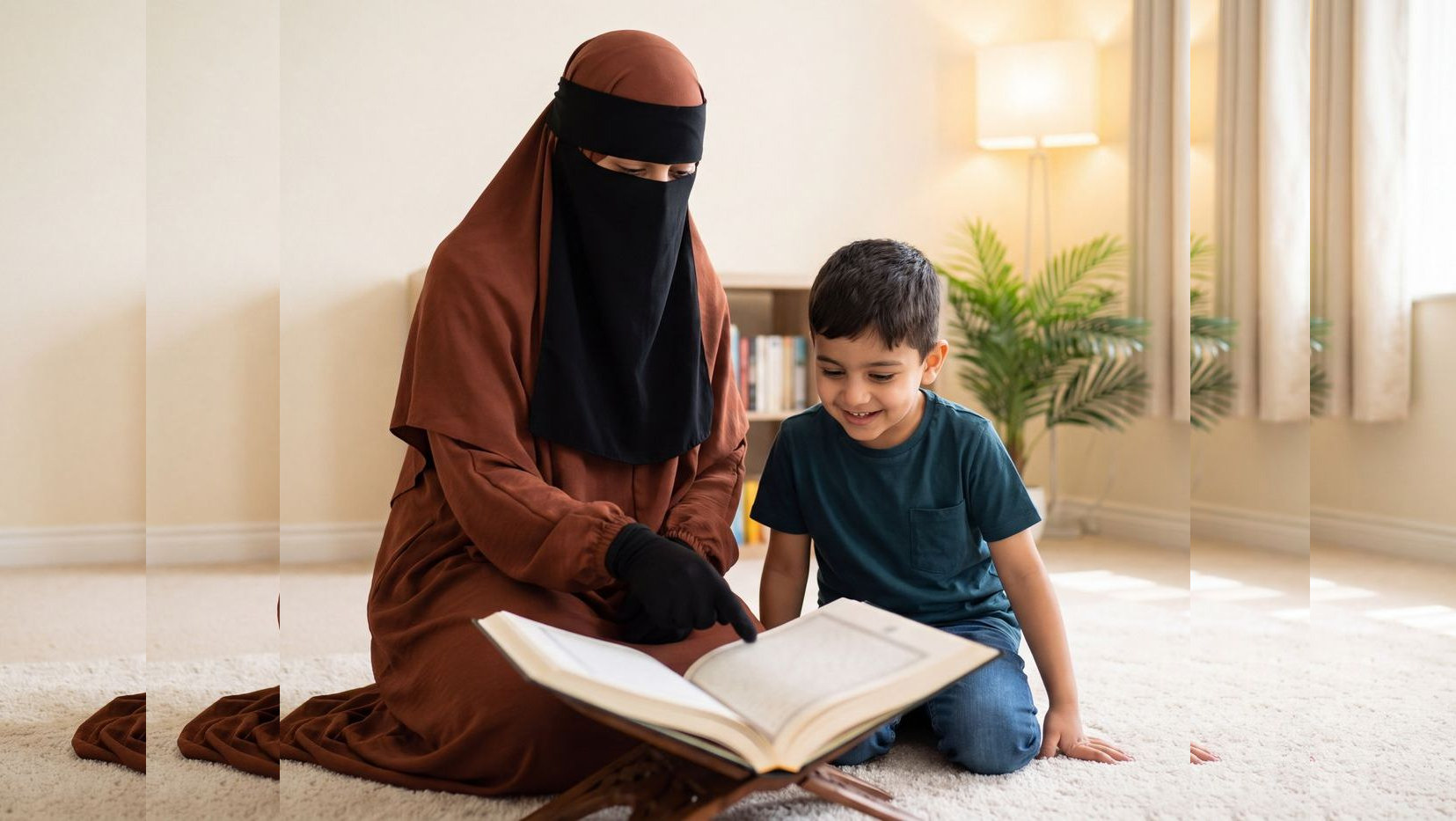
School finished at quarter past three. It’s now six, you’ve got tea to make and homework to check, and the Qur’an hasn’t been opened today. This book is built for that evening: ten minutes, at home, with you sitting beside them.
You don’t need to be a hafidh, and you don’t need Arabic. Your part is a home where the Qur’an is heard every day, and a parent who sits down beside them. The one thing you can’t do is hear your own child’s mistakes. That part needs a teacher.
إِذَا مَاتَ الإِنْسَانُ انْقَطَعَ عَنْهُ عَمَلُهُ إِلاَّ مِنْ ثَلاَثَةٍ: إِلاَّ مِنْ صَدَقَةٍ جَارِيَةٍ، أَوْ عِلْمٍ يُنْتَفَعُ بِهِ، أَوْ وَلَدٍ صَالِحٍ يَدْعُو لَهُ
When a person dies his deeds come to an end, except for three: an ongoing charity, knowledge that people benefit from, or a righteous child who supplicates for him.
A righteous child who makes du’a for you. You’re raising that child now, at the kitchen table, ten minutes at a time.
Part one
What you’re building.
Two short pages. The first is the order to teach in. The second is how much is really asked of you and your child, which is less than most parents fear.
The order the Companions learned in
Faith came before the Qur’an, and Luqman taught his son the same way
What success looks like
Three levels, and why every surah counts from the first one
The sequence
They learned faith first.
Jundub ibn Abdullah was one of the younger Companions. He described the order they were taught in.
كُنَّا مَعَ النَّبِيِّ صلى الله عليه وسلم وَنَحْنُ فِتْيَانٌ حَزَاوِرَةٌ، فَتَعَلَّمْنَا الإِيمَانَ قَبْلَ أَنْ نَتَعَلَّمَ الْقُرْآنَ، ثُمَّ تَعَلَّمْنَا الْقُرْآنَ فَازْدَدْنَا بِهِ إِيمَانًا
We were with the Prophet ﷺ, and we were young men close to manhood. We learned faith before we learned the Qur’an. Then we learned the Qur’an, and our faith increased by it.
Faith came first. Then the Qur’an, which made that faith grow. A child who knows a little about who Allah is hears His words differently from a child handed them as homework. Luqman teaches his son in the same order.
Who Allah is
لَا تُشْرِكْ بِٱللَّهِHe starts with who Allah is, before any rule.
Luqman 31:13
That Allah sees
إِنَّ ٱللَّهَ لَطِيفٌ خَبِيرٌAllah sees a mustard seed hidden inside a rock. This comes before any list of duties.
Luqman 31:16
Then the practice
أَقِمِ ٱلصَّلَوٰةَPrayer comes fourth in the passage. It rests on what came before it.
Luqman 31:17
Then the character
وَٱصْبِرْ عَلَىٰ مَآ أَصَابَكَPatience, humility and a lowered voice. These keep the practice going when life gets hard.
Luqman 31:17-19
What success looks like
Every surah counts, from the first one.
Many of us grew up thinking that if a child doesn’t finish the whole Qur’an, the years were wasted. The scholars have never made memorising the whole Book a personal duty on every child. Once you see the levels drawn out, most of that weight comes off.
Enough to pray
Every Muslim needs thisAl-Fatihah and a short surah, said well enough that the words keep their meaning. If your child has this, they’re not behind anybody.
A pocket of the Qur’an they carry
Worth aiming forThe last juz, the surahs they pray with, the ones they ask for at bedtime. Enough that the Qur’an becomes part of how they speak to Allah for life.
The whole Book
A gift, never a debtIf Allah opens this for your child, take it with both hands. If He opens something smaller, that’s not a failure, and every surah on the way counted in full.
Wherever your child settles, nothing below it is lost. A child who prays with al-Fatihah and three short surahs, and knows what they mean, has something many adults are still working towards.
There’s a second comfort. The Prophet ﷺ said the pen is lifted from a child until they grow up (Sunan Abi Dawud 4398), so nothing is being counted against them yet. Everything they learn before then is pure gain.
خَيْرُكُمْ مَنْ تَعَلَّمَ الْقُرْآنَ وَعَلَّمَهُ
The best of you are those who learn the Qur’an and teach it.
Sit with your child over one surah this week and you’re already learning and teaching the Qur’an. There’s no finish line to cross first.
Part two
Ten minutes a day, done well.
This part is for a parent with a job, a tea to cook and homework to check. Ten minutes a day, set up well, does more than an hour on a Saturday. Page 09 shows the research.
The five habits
What a Qur’an home does, and from what age
Little and often
The same minutes, spread two ways, with very different results
Close the book
The change to make first, and how to do it in 90 seconds
The best hour, and then sleep
When you sit down changes how the session goes
The home
Five habits, and none of them need you to teach.
You don’t have to be your child’s Qur’an teacher. Your job is to make the Qur’an ordinary in your house, and no teacher can do that from the other end of a video call.
01
They hear it before they read it
From birthRecitation playing in the kitchen and the car, and your own voice where they can hear it. The ear learns the sounds years before the tongue does.
02
A fixed slot, not a fixed mood
From age threeThe same ten minutes every day, tied to something that already happens: after Fajr, after Maghrib, before bed. Never when they’re hungry, tired or in the middle of a game.
03
The book closes before you finish
From the first surahEnd every session with them reciting from memory. Trying to remember is what builds the memory.
04
Yesterday, last week, last month
From the second surahThree quick touches on old work before anything new. Two minutes of revision protects a year of work.
05
They use it in their salah
From age sevenWhat they memorise goes into their salah as soon as they pray. A surah only ever recited to a teacher slips away easily.
Do not make your houses graveyards. Shaytan flees from a house in which Surah al-Baqarah is recited.
The narration compares a house where nothing is recited to a graveyard. The first habit above costs nothing and gives the most back. A child who has heard the Qur’an since they were a baby comes to a first lesson with an ear that already knows the sounds.
وَأْمُرْ أَهْلَكَ بِٱلصَّلَوٰةِ وَٱصْطَبِرْ عَلَيْهَا ۖ لَا نَسْـَٔلُكَ رِزْقًا ۖ نَّحْنُ نَرْزُقُكَ
And enjoin prayer upon your family, and be steadfast therein. We ask you not for provision. We provide for you.
Surah Ta Ha 20:132
Little and often
The same minutes, spent two ways.
A surah goes in well on Saturday. By the next Saturday most of it has gone. Both lines below use the same number of minutes, spread differently across a month.
What the research says
Across 317 experiments, material studied in separated sessions was retained far better than the same material studied in one block. In a later study of more than 1,350 people, the best gap between a first study and a review was roughly 10 to 20 per cent of how long the material had to last: about a day for a week, about a week for a month, about three weeks for a year.
Cepeda et al., Psychological Bulletin, 2006; Psychological Science, 2008
The rule of thumb: come back to it after about a tenth of the time you want it to last.
| You want it to last | Come back after about | In practice |
|---|---|---|
| A week | One day | Yesterday’s lines, at the start of today’s session |
| A month | One week | Last week’s surah, once, on the same day each week |
| A year | Three weeks | The monthly sweep: one old surah they haven’t touched |
What the research says
In a study that followed 96 people forming a new daily habit, the median time for it to become automatic was 66 days, with a range from 18 to 254. Missing a single day had almost no effect on the result.
Lally et al., European Journal of Social Psychology, 2010
Close the book
Reading is the warm up. Recalling is the work.
Most sessions at home end at step two. The child reads the page well while looking at it, and everyone goes to bed pleased. Two weeks later the surah has gone, and nothing about that evening warned you it would.
What the research says
Students who read a passage once and then tried to recall it from memory remembered far more a week later than students who read it four times over. Reviewed across dozens of experiments, recalling beats rereading by a medium to large margin (g = 0.50). The effect grows the longer the delay before the test.
Roediger & Karpicke, 2006; Rowland, Psychological Bulletin, 2014
Rereading feels useful and mostly isn’t. Hunting for a word you can’t find feels like failing, and it’s where the memory forms. When your child sits there with the book shut and stuck, you’re watching the useful part of the session. Wait through it.
Closing the book costs no extra minutes. It’s the difference between a child who has covered thirty surahs and a child who knows them.
Why this is the habit to change first
The hour you choose
Same child, same effort, a different hour.
Before you decide your child can’t concentrate, look at the hour you picked. Often the only slot that fitted your week is the worst one in their day. The scholars who wrote about teaching children said the same: choose a quiet time, after Fajr or between Maghrib and Isha, and avoid the hours when a child is hungry or tired.
After Fajr
The quietest time of day. Good for new lines
Straight after school
Hungry and tired. Usually the hardest slot of all
After a snack and a run around
Same child an hour later, and a different session
Between Maghrib and Isha
Everyone’s home. Good for revision out loud
Last thing before sleep
Two minutes of recall, then sleep
You may have heard that a child can concentrate for one minute per year of age. That’s a rule of thumb, and no study backs it. Attention grows slowly through childhood, and it depends on the task: how interesting it is, how hard it is, and whether they chose it. You can change all three tonight.
What the research says
Sleep is when the day’s learning is stored. Children spend a larger share of the night in slow wave sleep than adults do, and that is the stage that strengthens the kind of memory recitation depends on. What a child revises last thing at night is worked on while they sleep.
Reviewed in Emerging Topics in Life Sciences, 2023
Part three
Keeping them willing.
A method only helps if your child will still sit down for it in five years. This part is about getting the ten minutes done without using up their goodwill.
The sticker chart problem
Why the obvious reward can work against you
Three things every learner needs
And the sentences that give them
The pressure loop
How pushing harder makes recall worse, and the way out
The discipline question
The narration about seven and ten, read in full
Four kinds of “no”
What each one usually means, and what to try first
Motivation
A pound a page can work against you.
Most of us have tried a reward chart at some point. Here is what the research found about rewards promised in advance.
What the research says
A meta analysis of 128 experiments found that tangible rewards promised in advance for doing a task, finishing it, or doing it well all reduced people’s willingness to do that task freely afterwards (d = 0.40, 0.36 and 0.28). The effect was stronger for children than for university students. Unexpected rewards and rewards not tied to the task did not reduce it, and verbal praise generally raised it.
Deci, Koestner & Ryan, Psychological Bulletin, 1999
Here’s why. A child works out why they’re doing something. If a pound is waiting at the end, the pound becomes the reason. Take the pound away and the reason goes with it. When nothing is waiting, they find a reason of their own, and that’s the one you were hoping for.
If you memorise it, you get the toy
Reduces willingnessPromised in advance, with a condition. The child decides the surah is the price of the toy.
A pound for every page, every week
Reduces willingnessPaid by the amount, and expected every week. The child starts counting pages.
A celebration they did not know was coming
No measurable harmUnexpected, so it never becomes the reason. This is the feast for finishing a juz.
You worked hard at that difficult line
Raises willingnessPraise for the effort, said at the moment it happens. It costs nothing.
Scholars who suggest a prize for finishing a juz aren’t at odds with this, as long as the prize stays on the right side of that line. Announce the feast when the juz is done and you’ve thrown a celebration. Promise it in September for a juz by December and you’ve signed a contract. That’s how you end up with a child who negotiates.
What a learner needs
Three needs, and the sentences that meet them.
Research on motivation keeps finding the same three needs. Children have them too.
Some say in it
Which one, and when. A choice between two surahs, or of the hour, makes it theirs.
Which one shall we take today, an-Nas or al-Falaq?
The feeling of getting better
Progress they can see this week: the line that was hard on Monday and easier by Thursday.
Listen to that. On Monday you couldn’t get past the third word.
To be doing it with someone
Sitting alone at a table is the hardest version of this. Sitting beside a parent who is also reciting is the easiest.
Come and sit with me. I’m going to read mine too.
What the research says
Children whose parents support their sense of choice, by offering real options, explaining reasons and avoiding controlling language, show more motivation of their own, keep going longer and do better. Pressure and guilt get work done to avoid trouble, and it stops when the pressure lifts.
Reviewed in Joussemet, Landry & Koestner, Canadian Psychology, 2008
Listen for the words have to in your own mouth. “You have to do your Qur’an now” is pressure. “We’re doing ours after Maghrib. Would you like al-Falaq or an-Nas?” gives a time and a choice in one breath. It’s the same work, and your child will feel the two very differently.
The Messenger of Allah ﷺ had the finest character of all people. I had a little brother called Abu Umayr. Whenever the Messenger of Allah ﷺ came and saw him he would say: Abu Umayr, what happened to the little sparrow?
The Prophet ﷺ was leading a whole community. He still noticed that a small boy had a pet bird, and he asked the boy about it by name.
The trap
Why pushing harder makes the recall worse.
What the research says
Anxiety consumes working memory. A worried mind spends part of its capacity monitoring the threat, leaving less for the task, and the effect is largest on exactly the kind of verbal work reciting from memory requires. Anxious children perform worse than calm children on verbal memory tasks of identical difficulty.
Eysenck et al., Emotion, 2007; Ng & Lee, 2015
This loop is common, and it’s easy to fall into. If you recognise yourself in it, you’re not a cruel parent. You saw what was in front of you clearly and drew the wrong conclusion from it.
The Messenger of Allah ﷺ kissed al-Hasan ibn Ali while al-Aqra ibn Habis was sitting with him. Al-Aqra said: I have ten children and I have never kissed one of them. The Messenger of Allah ﷺ looked at him and said: the one who shows no mercy is shown no mercy.
Three supplications are answered, there is no doubt about them: the supplication of the parent, the supplication of the traveller, and the supplication of the one who has been wronged.
Discipline
“Command them at seven”, read in full.
One narration is quoted more than any other to defend a harder approach. It’s usually quoted short, which drops most of what it says.
مُرُوا أَوْلاَدَكُمْ بِالصَّلاَةِ وَهُمْ أَبْنَاءُ سَبْعِ سِنِينَ، وَاضْرِبُوهُمْ عَلَيْهَا وَهُمْ أَبْنَاءُ عَشْرِ سِنِينَ، وَفَرِّقُوا بَيْنَهُمْ فِي الْمَضَاجِعِ
Command your children to pray when they are seven years old, and smack them for it when they are ten, and separate them in their beds.
Its subject is the prayer. It says nothing about memorising, and nothing in it reaches as far as a Qur’an lesson. Ten is the earliest age it names, after three years of asking gently. The scholars who discuss it add that it must not be severe, must not be to the face, and that a teacher may not do it at all without the guardian’s permission. In UK schools, hitting a child is against the law.
I served the Prophet ﷺ for ten years. He never said to me a word of irritation, and never said of anything I did, why did you do that, nor of anything I left, why did you not do it.
Anas began serving the Prophet ﷺ at about ten, the very age in question, and stayed for ten years. In all that time he was never once asked “why did you do that?” The same Sunnah that has the narration above also records this, and this is the one you’ll live with at your kitchen table.
Troubleshooting
Four kinds of “no”, and what each one means.
A child who resists is telling you something. These four patterns look alike from outside, but they come from different places, and the wrong fix usually makes things worse. Find your row before you change anything.
| What you’re seeing | What it usually is | What to try |
|---|---|---|
| Suddenly refuses, after being fine | Something happened. Often one specific moment: laughed at, shouted at, or compared to a brother or sister. | Ask what happened, once, gently. Don’t defend the teacher before you’ve heard it. Fix the cause and the refusal often goes with it. |
| Willing, but nothing sticks | Rarely ability. Usually one long session a week instead of short daily ones, and reading instead of recalling. | Halve the session and double how often you do it. Close the book before you finish. Add the three quick touches of revision. |
| A fight every evening | The slot is wrong, or the amount is. A tired child is being asked to do a hard thing at the worst hour of their day. | Move the slot. Halve the portion for two weeks and let them win. A child who manages three lines comes back tomorrow. |
| Goes quiet and goes along with it | The most serious of the four, and the easiest to miss. Going along without joining in usually means they’ve decided this is something done to them. | Give back some control: the surah, the time or the order. Mend the relationship before the schedule. |
What the research says
Pooling 308 studies, the combination of high warmth and high expectations predicted the best academic outcomes. Harsh control, guilt and withdrawal of affection predicted worse ones. Warmth without expectation and expectation without warmth both underperformed the pair together.
Pinquart, Educational Psychology Review, 2016
Warmth on its own gives you a child nobody asked anything of. Expectation on its own gives you a child who complies until they’re old enough to stop. Holding both is what predicts the best results. It’s harder than either, because you keep the standard and the relationship alive in the same conversation.
Two particular children
The one who finds it hard, and the one who pulls away.
The child who finds it hard
Some children take four times as long per line as a brother or sister did, and no change of method seems to help. If that’s your child, read the next narration with them.
الْمَاهِرُ بِالْقُرْآنِ مَعَ السَّفَرَةِ الْكِرَامِ الْبَرَرَةِ، وَالَّذِي يَقْرَأُ الْقُرْآنَ وَيَتَتَعْتَعُ فِيهِ وَهُوَ عَلَيْهِ شَاقٌّ لَهُ أَجْرَانِ
The one who is proficient in the Qur’an is with the noble and obedient scribes. And the one who reads the Qur’an, stumbling over it, and it is hard for him, has two rewards.
The skilled reciter is with the angels. The child who stumbles, finds it hard and keeps going has two rewards. Allah rewards the struggle itself. Tell your child that, in those words, on a day it went badly.
وَلَقَدْ يَسَّرْنَا ٱلْقُرْءَانَ لِلذِّكْرِ فَهَلْ مِن مُّدَّكِرٍ
And We have certainly made the Qur’an easy for remembrance, so is there any who will remember?
Surah al-Qamar 54:17
If the difficulty seems out of proportion, especially if reading English is hard too, ask whether something like dyslexia is involved. That changes the method and keeps the goal: shorter portions, more listening, less decoding, and a teacher who is told in advance.
The teenager who has stopped
Around thirteen, a child who was fine at nine may pull away. Your instinct will be to tighten the rules, and that’s often what ends it. Scholars asked about this answer the same way: find out why he stopped before anything else, don’t shun him, keep your warmth where he can feel it, and put him with a teacher he trusts. At that age, the same words land differently from someone who isn’t his parent.
Part four
Arabic, and the teacher.
Two decisions most parents make without the facts in front of them: how much Arabic is enough, and how to tell a good teacher from a well spoken one.
Which Arabic, and how much
Three layers, and only the first is asked of everyone
Arabic in an English speaking house
What works when neither parent speaks it
What to look for in a teacher
Six questions to hold every teacher to, ours included
The trial lesson
25 minutes, and what to watch for
How much is enough
Arabic is three projects, not one.
You’ve heard that Arabic is part of the religion, and you may have decided your child needs to be fluent. There are three separate projects inside that idea. They take very different amounts of time, and only the first is asked of everyone.
Read the letters
The shortestDecoding the script and the vowel marks, then the rules that stop a reader changing a meaning by accident.
Every Muslim needs this one.
Understand what you recite
LongerThe words and grammar of the Book itself. Around 670 words, with their prefixes and endings, cover about 85 in every 100 words of the Qur’an.
This is where reciting starts to become understanding.
Speak it
The longestConversation, writing, and reading beyond the Qur’an. A good goal, and a separate project.
Worth having, but never at the cost of the first two.
Ibn Taymiyyah held that because understanding the Qur’an and the Sunnah depends on Arabic, knowing it is a duty: some of it on everyone, the rest on the community as a whole (Iqtida’ as-Sirat al-Mustaqim). Umar ibn al-Khattab told people to learn Arabic. A longer version, saying it sharpens the mind and adds to a person’s honour, is weak. The instruction itself is what stands.
What the research says
An analysis of grammar test results from 669,498 people found that the ability to absorb the grammar of a new language holds up strongly through childhood and adolescence before declining. Reanalysis disputes how sharp the drop is, but not its direction. Starting earlier is easier, and starting later still works.
Hartshorne, Tenenbaum & Pinker, Cognition, 2018; Slik et al., 2022
In practice
Arabic in a house where nobody speaks it.
This is the usual case, and there’s a lot you can do. Your aim is to close the gap between reciting and hearing, so that one day your child catches whole phrases in the imam’s recitation without stopping to translate. Speaking Arabic like a native is a different project, and not the one in front of you.
670
words make up around 85 per cent of the Qur’an’s text
1
new word at the end of each ten minute session
260
words in a year, at five sessions a week
The one word rule does most of the work. At the end of the ten minutes, take one word from what they just recited and tell them what it means. Tomorrow, ask for that word before you give the new one. The Qur’an repeats its words a lot, so the ones your child learns early are the ones they’ll keep meeting.
Teach the word inside the ayah, never on a list
A word met in its verse has something to hang on. A word on a flashcard doesn’t.
Say the meaning, then say the ayah again
So they hear the ayah differently the second time.
Use a translation they can read easily
A child struggling with old-fashioned English is being taught two hard things at once.
Let them ask about a word you can’t answer
Say you don’t know, and look it up together. That’s a lesson too.
Start with the words of al-Fatihah
Once they pray, they say it in each of the 17 fard rak’ahs a day, so its words come back most often.
Keep the alphabet and the meanings apart
Reading the script and understanding the language are separate skills. Don’t hold one back waiting for the other.
Choosing
What predicts progress, and what parents choose on.
You’ve heard that surah so often that your mind fills in what it expects. A trained ear hears what really came out. That’s the main thing you’re paying for.
What predicts progress
What parents usually choose on
Can hear a mistake your ear misses
Speaks perfect English
Corrects the reading, never the child
Is the cheapest available
Knows where your child is today
Has the most impressive title
Turns up, every week, on time
Promises a juz by a date
Tells you the truth about progress
Only ever gives good news
Has been checked, and can tell you how
Was recommended by someone you like
Character matters more than the certificate. Your child’s feeling about the Qur’an takes shape in these lessons, so a patient teacher is worth more than any title.
Six questions for any teacher
| Ask | What you’re listening for |
|---|---|
| What will you do in the first month? | A good answer starts with hearing your child read. A vague promise of a juz is a warning sign. |
| How do you correct a mistake? | Is the correction aimed at the reading, or at the child? This question tells you the most. |
| What do you do when a child won’t focus? | You want curiosity about the cause, not a list of penalties. |
| Who did you study with, and what did you finish? | A qualified teacher answers this easily. If they mention an ijazah, ask to see it. |
| How will I know it’s working? | If they can’t say what progress looks like in eight weeks, they haven’t thought about your child yet. |
| How were you checked to teach children? | Listen for named steps. In the UK, ask about an enhanced DBS check. A teacher abroad usually can’t get one, so ask what checks they passed. |
The trial lesson
25 minutes, and what to watch for.
You don’t need to judge the teacher’s tajweed. The signs below matter more, and the biggest is what happens in the two seconds after your child makes a mistake. That moment will come up in every lesson for years.
Book a second lesson
Starts by finding out what your child can already do
Corrects gently, and has your child repeat it correctly before moving on
Lets silence sit while your child works something out
Speaks to your child, not about them to you
Ends with something your child got right
Keep looking
Talks for most of the lesson without hearing your child read
Sighs, tuts, or lets frustration show in the voice
Compares your child to another student
Sets a target before assessing anything
Your child goes quiet and stays quiet
Safeguarding, briefly
Keep lessons in a shared room, not a bedroom
Online lessons too. Door open, and the screen facing into the room.
Keep messages on the platform the lessons are booked on
A teacher who moves a child to private messaging is worth asking about.
Tell your child they can tell you anything about a lesson
Say it once, before the first lesson, so talking about it feels normal.
Print this page
The whole guide, on one sheet.
Put it on the fridge. If you only keep the first block, you’ve kept most of the book.
Every day
Ten minutes, same slot, never when hungry or exhausted
Two minutes of yesterday and last week, before anything new
End with the book closed and the child reciting
Recitation playing somewhere in the house
Every week
One lesson with a teacher who can hear what you can’t
One surah revised that they haven’t touched in a month
One conversation about a meaning, not a target
Never
A reward promised in advance for a set amount memorised
A comparison to a sibling, a cousin or another student
 My Tijarah
You can’t hear your own child’s mistakes.
Nobody can, in their own child. You’ve heard that surah a hundred times, so your mind fills in what it expects to hear. Everything else in this book happens at your kitchen table. This one part needs a teacher listening only to your child.
We can’t promise a result by a date. We can help you find a teacher your child gets on with.
150+ teachers, each checked by hand: identity, qualifications, then approval by our team (11 October 2026)
65 female teachers, and 156 intro videos you can watch with your child before you book
Lessons happen on the platform, from about £6. Each teacher sets their own price.
Bring this book to your child’s trial lesson. Ask the teacher the six questions on page 22, and afterwards ask your child the two on page 23.
Not booked yet? Try up to 3 teachers free: 3 free trial lessons with up to 3 different teachers. No card needed. Keep the teacher your child asks for. You don’t have to decide today.
Find your child a teacher
mytijarah.co.uk/find-teachers