 My Tijarah
The Qur’anReadingRoadmap
Fifteen minutes a day, from your first letterto your first ayah.
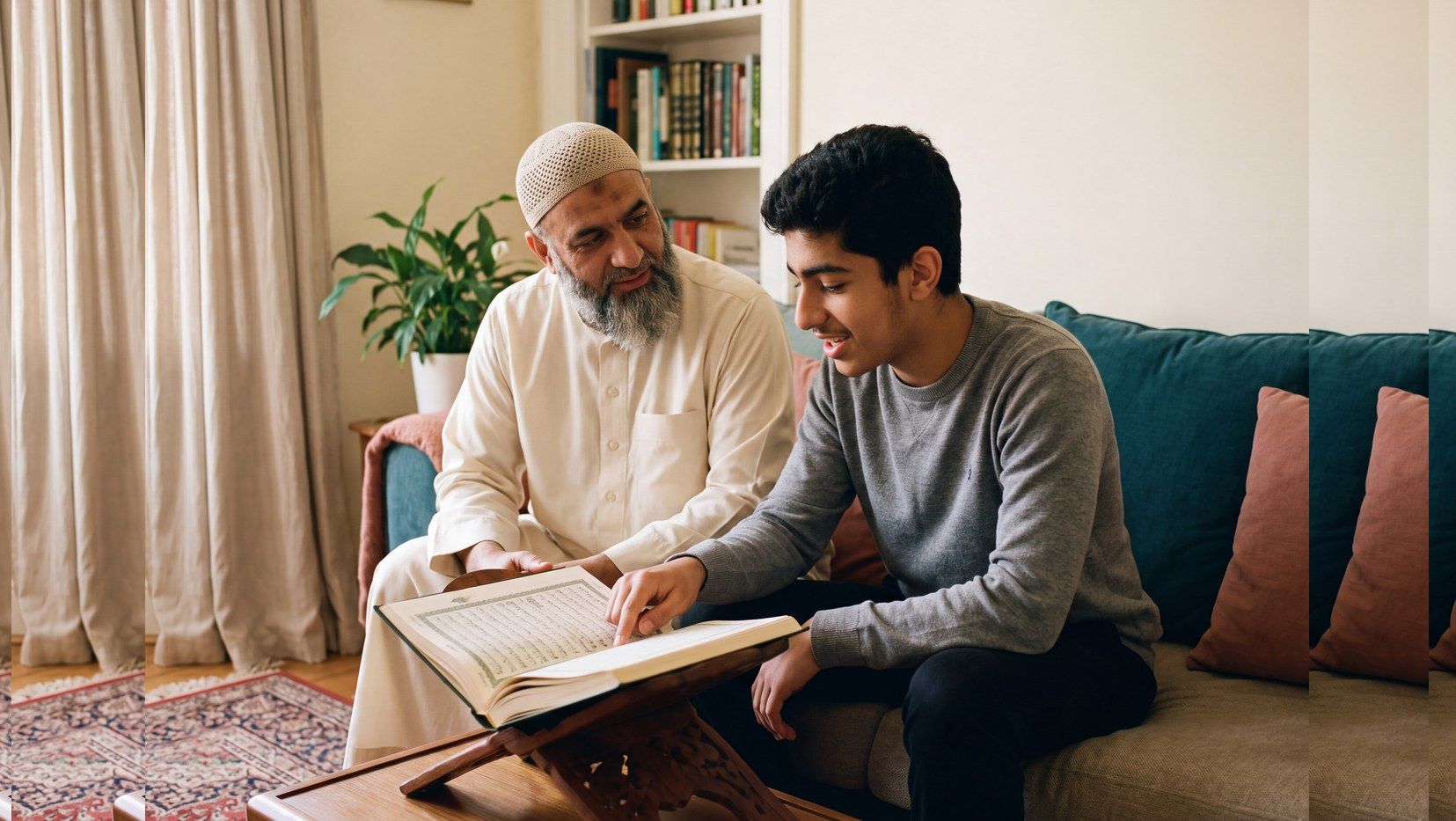
What is inside
Contents
Before you start
- The whole system, on one pageAnd 10 minutes to try tonight
- How to use these pagesFifteen minutes, and the one thing a page can’t do
Part one: the letters
- All 28, with their soundsName, shape and what to do with your mouth
- Twenty eight letters, fifteen shapesThe dots do most of the work
- Where each sound is madeThe hollow, the throat, the tongue, the lips, the nose
- Eight pairs that change the wordHeart or dog, clay or fig, created or shaved
Part two: joining
- Every letter has four facesAlone, at the start, in the middle, at the end
- The six that never join forwardsAnd the gaps they leave behind
- Fifteen words to take apartYour first real reading
Part three: the marks
- The three vowels, short and longThe one idea that holds it all together
- SukoonThe letter that stops
- ShaddahOne letter written, two letters read
- TanweenThe n you can hear but never see
- How long is longTwo counts, four, and six
- The marks only a mushaf hasDagger alifs, small letters and two kinds of zero
Part four: from letters to ayaat
- The sun and the moonThe one rule you can see instead of remember
- The alif you skipWhy it’s bismillah, not bism illah
- Stopping wellThe last letter, and the signs that tell you where
- Your first ayah, taken apartBismillah, rule by rule
- A whole surah, rule by ruleAl-Ikhlas, every mark named
Part five: thirty days
- How the thirty days workFive minutes learning, five drilling, five reading
- Day 1 to day 30The whole plan, on two pages
- Nine things that hold readers backAnd which ones to fix first
- What comes after thisOne last line to read, and your next step
The promise
There is far less to learn here than you think.
Twenty eight letters, drawn with fifteen shapes. Three vowels. One mark that says a letter has no vowel at all. That’s the whole alphabet and the whole vowel system of the Qur’an, and all of it is on this page.
28 letters
15 shapes
Fifteen shapes, and the dots do the rest.
ب ت ث ن3 short vowels
a, i, u
One above, one below, one above.
بَ بِ بُ3 long vowels
aa, ee, oo
The same three sounds, held for two counts.
بَا بِي بُو1 mark for no vowel
the sukoon
The letter closes, and stops.
بْShaddah
بّthe letter, twice
Tanween
بً بٍ بٌthe vowel, plus an n
This book teaches you to read the words correctly. That part comes first. It won’t make you a reciter: the rules on top, like the nun sakinah and the heavy lam, come later, from a teacher who can hear you. Page 25 shows where that road starts.
How to use it
Fifteen minutes a day, out loud.
One rule beats everything else in this book. Read out loud. You can’t hear your own mistakes inside your head, and a letter you’ve only ever looked at is a letter you can’t say yet.
Recitation is a sunnah that is followed, taken by the later from the earlier.
That line is reported from the Companions, and the generations after them repeated it. People heard the Qur’an long before anyone wrote it down, and scholars have warned ever since against taking recitation from a page alone. Use this book for the system. Use a teacher, a parent or a friend who reads well for the sound.
If it feels hard, read this twice
The Prophet ﷺ said that the one who is skilled in the Qur’an is with the noble and obedient scribes, and the one who reads it haltingly, and it is hard for him, has two rewards.
Narrated by Aishah. Sahih Muslim 798.
If you’re an adult starting again, or starting from zero, and a bit embarrassed about it, read that line twice. Finding it hard isn’t a mark against you.
30
days in the plan
15
minutes a day
0
Arabic you need to start
Three things to have beside you
A printed mushaf
This book follows the Madinah print. If yours is the South Asian print many people in Britain learnt from, a few marks look different. The letters and vowels don’t.
A pencil
You’ll circle letters and mark pages. Writing on your own copy shows you what you can’t read yet.
Somebody who will listen
Once a week is plenty at the start. They don’t have to be a scholar. They have to hear a wrong letter and say so.
Part one
The letters.
Twenty eight of them, and a system of dots that makes them look like far more. Get these solid in week one. Every later page uses them.
All 28, with their sounds
Name, shape, and what your mouth has to do
Fifteen shapes
The skeleton, and the dots that name it
Where a sound is made
Five regions, from the throat to the lips
Eight pairs that change the word
Where one wrong letter is a different word
Part one
The 28 letters
The hamzah, the twenty ninth sound
The catch in the middle of “uh oh”. It has no seat of its own, so it sits on an alif, a waw or a ya, or on the line by itself: أ إ ؤ ئ ء
The shapes
Twenty eight letters, drawn with fifteen shapes.
Look at ب ت ث ن ي. One shape, five times over. Inside a word they’re drawn the same way, and only the dots tell them apart. Same story with ج ح خ, with ص ض, ط ظ, ع غ, س ش, ف ق, د ذ and ر ز.
one tooth, one to three dots
dot below, none, dot above
the dot is the only difference
three teeth, bare or dotted
a loop and a tail
a loop with a mast
one dot, then two
a hook
a hook that dips below the line
a single stroke
its own shape
its own shape
its own shape
its own shape
its own shape
The biggest family, told apart by dots alone
bā’
one, below
tā’
two, above
thā’
three, above
nūn
one, above
yā’
two, below
What to do with that
So you’re learning 15 shapes and one habit: find the skeleton, then read the dots. Fluent readers work in that order without thinking. Start that way now and there’s nothing to unlearn later.
One thing to know
On their own, ن and ي keep bowls of their own, and ف and ق part company in their tails. The families above show how these letters look inside a word, which is where you’ll meet nearly all of them.
The sounds
Every letter has an address in your mouth.
Every Arabic letter is made in one fixed place. The scholars mapped seventeen places in five regions, from the bottom of the throat out to the lips. The five regions are all you need for now. They explain why a few letters feel impossible at first: English never uses that part of your mouth.
Cross section after Tavin, Wikimedia Commons, CC BY 3.0
The empty space itself. It shapes the three long vowels and nothing else.
Three depths, two letters each. Four of the six have no match in English.
Eighteen letters across ten points, from the very back of the tongue to its tip.
The easiest four. English has all of them: f, b, m and w.
The hum you hear inside these two. Pinch your nose and it dies.
The pairs
Where one wrong letter is a different word.
Each line below is two real Arabic words, one letter apart. Swap the letter and whoever is listening hears the other word. Scholars call this lahn jali, the clear error. It’s why correct letters come before everything else in this book.
ق is made further back than ك, against the soft palate.
Swallow the ع and an attribute of Allah becomes a description of punishment.
ح is smooth and breathy, خ scrapes.
ح comes from the middle of the throat, ه from the very bottom.
Opposite meanings, one letter apart, and you say it in al-Fatihah.
ط fills the mouth. ت is light and flat.
Same tongue tip. The back of the tongue is what moves.
And زَلَّ, zalla, is he slipped. Three letters, three words.
You say one of these every day
Al-Fatihah ends وَلَا ٱلضَّآلِّينَ. Say the ض as a د and you’ve said dāllīn, from a root meaning to guide, inside a sentence asking Allah to keep you from the opposite.
How to fix one
Say both words back to back, ten times, slowly. Then ask somebody whether they can hear a difference. If they can’t, you’re still making one sound. A listener gets you further than any written explanation can.
Part two
Joining.
Arabic joins up, always. A letter changes shape depending on where it stands, and six letters refuse to join to whatever comes after them. That’s all of it.
Four faces
Alone, at the start, in the middle, at the end
The six that never join forwards
ا د ذ ر ز و, and the gaps they make
Fifteen words to take apart
Read each letter, don’t guess the shape
Joining
Every letter has four faces.
A letter looks different depending on whether it stands alone, opens a word, sits inside one, or closes it. The changes aren’t random. The letter keeps its core shape and gains or loses a joining stroke, and that holds for almost all 28.
All four faces of one letter, in one word
yatabayyana
Five teeth in a row, four different letters, and not one of them drawn the way it looks standing alone. Surah al-Baqarah, ayah 187.
When a word looks unreadable
Don’t stare at the whole thing. Start from the right, take one letter at a time, and say each one out loud as you go. Speed comes last, so don’t chase it yet.
Watch for the ligature
Lam followed by alif is written as a single joined shape. You read it lā, and some books count it as a twenty ninth letter, which it isn’t.
Joining
Six letters never join to what follows.
These six take a join from the letter before them, then refuse to pass it on. You get a gap inside a word that looks exactly like the space between two words.
All three letters join
A gap opens in the middle
Try it
Each of these is one word. Say how many letters it has before you look at the answer.
3 letters
2 gaps
4 letters
3 gaps
5 letters
3 gaps
8 letters
1 gap
Practice
Fifteen words to take apart.
Letters on top, the word underneath. Cover the bottom half with a finger, read the letters out loud from right to left, and join them up before you look.
kataba
he wrote
‘alima
he knew
naṣara
he helped
khalaqa
he created
warada
he came upon
aḥad
one
razaqa
he provided
dakhala
he entered
ṣadaqa
he told the truth
ḥamd
praise
yawm
a day
‘abd
a servant
sami‘a
he heard
fataḥa
he opened
shakara
he gave thanks
If a word will not come
Don’t guess from the shape. Go back to the rightmost letter, name it, then move one letter left. Guessing feels quicker at first, then stops working.
About the marks above and below
You haven’t met those yet. Ignore them today and name the letters. The transliteration shows you where you’re heading. Part three teaches the marks, one page each.
Part three
The marks.
The letters give you the consonants. Everything above and below the line gives you the vowels, the stops and the doubling. Six marks in all, and here they are.
The three vowels
Short, and the same three held long
Sukoon and shaddah
No vowel at all, and the letter written once but read twice
Tanween
An n at the end that is never written
Length, and the mushaf’s own marks
Two counts, four, six, and the small letters
The vowels
Three sounds, each with a short form and a long one.
Arabic has three vowels. Each one has a short form, written as a mark above or below the letter, and a long form, written as a whole letter after it. The long one is the short one, held about twice as long.
fathah
فَتْحَة
as in “but”
hold it, and it becomes
the mark is a small alif, laid on its side
kasrah
كَسْرَة
as in “bit”
hold it, and it becomes
the mark is a small ya, written underneath
dammah
ضَمَّة
as in “put”
hold it, and it becomes
the mark is a small waw
Drill: read across, out loud, without hurrying
The marks
Sukoon: the letter that stops.
A small mark shaped like the head of a خ tells you the letter carries no vowel. Say the consonant and stop there. Nothing comes after it. The most common habit to break is a faint “uh” on the end of a sakin letter. Listen for it in your own reading from today.
Two rules that never break
- You can’t begin a word on a letter with a sukoon. A word starts with a vowel sound on its first letter.
- Two sakin letters can’t sit together inside a word. If you think you’ve found a pair, look again. One of them carries a mark you’ve missed.
The shape of a syllable
Every Arabic syllable starts with a consonant and a vowel, and a sukoon closes it. That is the rhythm of the whole language, and it is why أَنْعَمْتَ breaks into an · ‘am · ta and cannot break any other way.
Drill: land on the letter and stop
Then in the middle of a word, where it is harder
The marks
Shaddah: written once, read twice.
A shaddah tells you the letter is there twice: the first with a sukoon, the second carrying whatever vowel sits above or below. Hold the letter, then release it into the vowel. رَبَّنَا comes out rab · ba · nā, and it takes longer to say than rabanā.
‘alima
he knew
‘allama
he taught
iyyāka
You alone
You can’t start on one
A shaddah opens with a sakin letter, and no Arabic word starts on a sukoon. So a word beginning with a doubled letter always has something in front of it: an alif, or the word before it running on.
Drill: hold, then release
How to hear whether you are doing it
Say rab. Stop dead for a beat. Then say banā. Now close the gap until the two run together without either one disappearing. If somebody listening can’t tell رَبَّنَا from rabanā, you are still saying the letter once.
The marks
Tanween: the n you never see.
Double any of the three vowel marks and you have a tanween. You read it as the vowel followed by an n, and nobody writes that n as a letter. It turns up only at the end of a word, and only on nouns.
two dammahs
أَحَدٌaḥadun
two fathahs
كِتَابًاkitāban
two kasrahs
رَحْمَةٍraḥmatin
The alif that is not a sound
Two fathahs usually sit on an alif at the end of the word, as in كِتَابًا. That alif is a seat and you do not say it. Carrying on, the word is kitāban. Stop on it and the n drops, and the alif finally gets to be a vowel: kitābā.
Stopping removes it
Stop on a word and its tanween goes with it. أَحَدٌ read on is aḥadun. Stopped on, it is aḥad. This catches a lot of people out the first time one word sounds different twice on the same page.
Drill: say the n, then take it away
A piece of grammar you get for free
kitābun
a book
al-kitābu
the book
A tanween and the word ال never sit on the same word, because they do opposite jobs. The tanween is Arabic for a. ال is Arabic for the. You’ve just learnt to tell definite from indefinite.
Length
How long you hold it.
Hold a long vowel for two counts, and a count is roughly the time it takes to fold one finger. Two is the answer most of the time. When a long vowel runs into a hamzah or a sukoon it stretches further, and you will see a small wave over the letter telling you so.
Natural
المَدُّ الطَّبِيعِيّ2 countsA madd letter with no hamzah and no sukoon after it.
every long vowel you have read so far
Joined
المَدُّ المُتَّصِل4 or 5 counts, your teacher picksA madd letter, then a hamzah, inside the same word.
you must stretch it; your teacher picks how far
Separated
المَدُّ المُنْفَصِل4 or 5 counts, your teacher picksA madd letter ends the word and a hamzah begins the next one.
only when you read the two words joined together
Because you stopped
المَدُّ العَارِض لِلسُّكُون2, 4 or 6 counts, your teacher picksA madd letter sits just before the letter you choose to stop on.
carry on instead of stopping and it disappears
Compulsory
المَدُّ اللَّازِم6 countsA madd letter followed by a sukoon or a shaddah that never goes away.
the longest stretch in the Qur’an, and the one with no choice
The mushaf
The marks that are only in a mushaf.
The Qur’an is printed in a script that preserves how it was first written down, older than the vowel marks and sometimes older than the spelling you would use today. Instead of changing the letters, scholars added a few marks to bridge the two. Many readers are never shown them, yet they’re on every page.
The dagger alif
الأَلِف الخَنْجَرِيَّة
A full long “aa” that the old script never wrote. Read it as an alif.
The small waw
الوَاو الصَّغِيرَة
A long “oo” on the ha that means “him” or “his”.
The small ya
اليَاء الصَّغِيرَة
A long “ee” on the same ha, after a kasrah.
The joining alif
هَمْزَة الوَصْل
Read it only when you start here. Skip it completely when you carry on.
The round zero
الصِّفْر المُسْتَدِير
Written but never spoken, whether you stop or carry on.
The upright zero
الصِّفْر المُسْتَطِيل
Silent when you carry on. Spoken as a long “aa” when you stop on it.
The two zeros, in one line
A round zero means the letter is dead. Written, never said. An upright zero means it is asleep: silent while you read on, awake as a long vowel the moment you stop on it.
Where you will meet them first
The round zero sits on the alif after a plural verb ending in ū: قَالُوٓا۟, ءَامَنُوا۟. You’ll meet it again and again. Read them qālū and āmanū, and never sound that last alif.
Part four
From letters to ayaat.
Four things stand between reading a word and reading a line: the word for the, the alif you skip, knowing how to stop, and then doing it. Here are the four, and two ayat taken apart.
The sun and the moon
The rule the page tells you, if you look
The alif you skip
Bismillah, not bism illah
Stopping well
The last letter of a word, and where you may stop at all
Two worked examples
Bismillah, and the whole of al-Ikhlas
The article
The sun and the moon.
Arabic makes a word definite by putting ال in front of it. Sometimes you say that lam and sometimes you do not, and the letter that follows decides. Fourteen letters take the lam. Fourteen swallow it.
Moon letters
الحُرُوف القَمَرِيَّةThe lam is pronounced. It carries a sukoon, and the letter after it is plain.
Sun letters
الحُرُوف الشَّمْسِيَّةThe lam is silent. The letter after it doubles instead, and carries a shaddah.
If you would rather learn them
The classical mnemonic. Its fourteen letters are the fourteen moon letters, in a phrase short enough to keep. Anything not in it is a sun letter.
Read these six and say which is which
al-ḥamd
moon
an-nās
sun
al-kitāb
moon
aṣ-ṣamad
sun
al-falaq
moon
ad-dīn
sun
The article
The alif you skip.
Some alifs at the start of a word are there to get you started and nothing else. Begin reading there and you say one. Arrive from the word before and you slide straight past it. You will see it marked with a small ٱ, a tiny head of a ص sitting on the alif.
Starting here
ٱللَّهُ ٱلصَّمَدُ
Al‑lā‑hu ṣ‑ṣa‑mad
You begin on the alif, so you say it.
Arriving from the word before
هُوَ ٱللَّهُ
hu‑wal‑lā‑hu
The alif vanishes and the lam closes the syllable before it.
If you do start on one, which vowel?
On “the”, always a fathah
Every ال begins with an a sound.
On a verb, look at its third letter
A dammah there, and you start with a dammah. A fathah or a kasrah, and you start with a kasrah.
On one of the seven nouns, a kasrah
اسم، ابن، ابنة، امرؤ، امرأة، اثنان، اثنتان.
Stopping
How to stop, and where.
Stopping is more than running out of breath. Stop on a word and its last letter changes, and three small rules cover nearly everything you will meet.
Drop the final vowel
Whatever mark the last letter carries goes silent when you stop there.
Two fathahs become a long aa
The n goes, and the alif underneath it finally gets to be a vowel.
The round ta becomes an h
ة is a t while you carry on and a soft h the moment you stop.
And the signs that tell you where
Stop
Carrying on would join two ideas that do not belong together.
Do not stop
Unless it falls at the end of an ayah, where stopping is always allowed.
Either
Stopping and continuing are both sound.
Better to carry on
You may stop, but the meaning sits better joined.
Better to stop
You may carry on, but the meaning sits better apart.
One or the other
Two sets of three dots. Stop at one of them, never at both.
Worth knowing about these signs
They’re not part of the revelation. Later scholars added them to guide the meaning, printings differ a little, and most of the Qur’an carries no sign at all. Where there is none, stop wherever the sense allows and your breath runs out.
The safest place to stop
The end of an ayah, every time. Stop there far more often than a fluent reciter does. A stop you chose beats one your lungs chose for you halfway through a word.
Worked example
Your first ayah, taken apart.
Most of the rules you’ve learnt are in this one line, and you’ve heard it more often than any other. Read from the right. The chips under each word name what is happening in it.
Now read it as syllables, joined
bis·mil·lā·hir·raḥ·mā·nir·ra·ḥīm
And the line after it
Joined, that is
al·ḥam·du·lil·lā·hi·rab·bil·‘ā·la·mīn
Three things to notice
- There is no alif in بِسْمِ. The old script left it out, and the reading never had one.
- You never say “bism illah”. The joining alif on ٱللَّه gets skipped, and the lam attaches to the m in front of it.
- ر is a sun letter, twice over. That is why it is ar-Rahmān and ar-Rahīm, with no lam sound in either.
If you stop at the end
The kasrah on the last letter of ٱلرَّحِيمِ goes silent, and you can hold the long ي before it for two, four or six counts, because it now sits in front of a letter you have stopped on. Whichever your teacher gives you, keep it the same every time.
Worked example
A whole surah, rule by rule.
Surah al-Ikhlas. Four ayat, and between them nearly everything you’ve learnt. Cover the transliteration and read the Arabic.
Part five
Thirty days.
A day is fifteen minutes: five learning, five drilling out loud, five reading real text. Four weeks of building, then two days to see whether it worked.
The letters
All 28, their shapes and their sounds
Joining and the short vowels
Four faces, then a, i and u
The marks
Sukoon, shaddah, tanween, and length
The mushaf itself
The article, the skipped alif, stopping
The plan
How the thirty days work.
The plan is small on purpose. Fifteen minutes is short enough to do on a bad day, and the bad days decide whether you finish this or start it again next year.
5 min
Learn
Read today’s page once, slowly.
5 min
Drill
Say the day’s letters or marks out loud until you stop having to think about them.
5 min
Read
Open a mushaf and use it on real text, even if it is three words.
Out loud, always
If somebody in the next room can’t hear you reading, you’re not doing the drill. For more drills, use this book’s workbook, Read the Qur’an Out Loud.
Never skip the drill to learn more
Saying a thing again builds reading. Covering more pages doesn’t. Five slow minutes on today’s six letters beats twenty minutes of reading ahead.
Don’t memorise anything yet
Hifdh built on shaky reading has to be unpicked later, and unpicking is far harder than learning. Read first.
Get corrected once a week
A parent, a friend, an imam, a teacher. Anyone who will stop you the moment they hear a wrong letter, before it sets.
What one sitting looks like
Learn
Read the shaddah page. Look at رَبَّنَا and see the letter written once and read twice.
Drill
Say the twelve words on that page out loud, twice through, slowly.
Read
Open al-Fatihah and find every shaddah on the page. Say those words aloud.
That’s day 17: fifteen minutes, and about 30 words with a shaddah said out loud.
If you miss a day
Carry on from where you stopped. Don’t start again, and don’t try to make up two days at once. Thirty sittings is thirty sittings, whether they take a month or two.
The best fifteen minutes to use
Straight after a prayer. The time is already there and you’re already sitting down. Finding the slot is the hard part, so tie it to something already fixed.
The plan
Day 1 to day 15
Fifteen minutes. Five learning, five drilling, five reading.
| Day | Learn | Drill, out loud | Read |
|---|---|---|---|
| 1 | Letters 1 to 7: ا ب ت ث ج ح خ | Name, then sound, ten times each, out loud. | Find all seven on one page of any mushaf. |
| 2 | Letters 8 to 14: د ذ ر ز س ش ص | Yesterday’s seven first, then today’s. | Circle every ص you can find in Surah an-Nas. |
| 3 | Letters 15 to 21: ض ط ظ ع غ ف ق | The heavy ones slowly. Feel the back of the tongue lift. | Find ق and ك on the same line and say both. |
| 4 | Letters 22 to 28, and the hamzah | All 28 in order, twice, without looking. | Read the letter names off the page, right to left. |
| 5 | Fifteen skeletons | Sort all 28 letters into their shape families. | Point at ten letters at random and name each one. |
| 6 | The six throat letters | ء ه ع ح غ خ. One minute each, in front of a mirror. | Say قَلْب then كَلْب. Ask someone if they can hear the difference. |
| 7 | Checkpoint | All 28 from memory. Record it on your phone and listen back. | Anything you can’t name goes on tomorrow’s list. |
| 8 | Four faces: alone, start, middle, end | Write ع and ه in all four positions, ten times. | Open any page and find one letter in all four faces. |
| 9 | The six that never join forwards | ا د ذ ر ز و. Spot the gap they leave. | Break قَالُوا and وَرَدَ back into their letters. |
| 10 | Fathah | Every letter with a fathah, right through the alphabet. | مَنْ، لَكَ، وَمَا |
| 11 | Kasrah | The alphabet again, this time with a kasrah. | بِـ، لِـ، مِنْ |
| 12 | Dammah | The alphabet a third time, with a dammah. | هُوَ، كُنْ، رُسُل |
| 13 | All three, mixed | Thirty syllables at random. Don’t guess. Decode. | Read the first line of Surah al-Falaq, vowel by vowel. |
| 14 | Checkpoint: three letter words | Twenty words, out loud, slowly, no guessing. | خَلَقَ، كَتَبَ، عَلِمَ، رَزَقَ |
| 15 | Sukoon | Land on the letter and stop. No “uh” after it. | مِنْ، قُلْ، لَمْ، أَنْتَ |
The plan
Day 16 to day 30
The marks, the mushaf, and then the test.
| Day | Learn | Drill, out loud | Read |
|---|---|---|---|
| 16 | Sukoon in the middle, and qalqalah | ق ط ب ج د with a sukoon. Let each one bounce. | يَلِدْ، أَحْسَنْ، ٱقْرَأْ |
| 17 | Shaddah | Say the letter twice, then let the two merge. | رَبَّنَا، إِنَّ، عَلَّمَ، إِيَّاكَ |
| 18 | Tanween | Three endings: un, an, in. Listen for the n. | أَحَدٌ، كِتَابًا، رَحْمَةٍ |
| 19 | Madd: two counts | Fold a finger for each count. Never one, never three. | قَالَ، يَقُولُ، نُوحِيهَا |
| 20 | The longer madds | Four counts, then six. Keep them apart. | ٱلسَّمَآءِ، ٱلضَّآلِّينَ |
| 21 | Checkpoint: Surah al-Kawthar | Three ayat, slowly, twice through. | Then once more with your finger on the line. |
| 22 | The sun and the moon lam | Look for the sukoon on the lam. It answers the question. | ٱلْقَمَر، ٱلشَّمْس، ٱلْحَمْد، ٱلرَّحْمَٰن |
| 23 | The alif you skip | Start on it, then join and drop it. | قُلْ هُوَ ٱللَّهُ أَحَدٌ |
| 24 | The small letters and the two zeros | Hunt for a dagger alif and a round zero on one page. | ذَٰلِكَ، لَهُۥ، بِهِۦ، قَالُوٓا۟ |
| 25 | Stopping well | Drop the last vowel. Turn ة into h. Turn an into ā. | رَحْمَةٌ، أَحَدٌ، كُفُوًا |
| 26 | The stopping signs | Mark up one page in pencil: stop, carry on, either. | A page of juz Amma, obeying every sign. |
| 27 | Checkpoint: al-Fatihah | Out loud, to another person, at half speed. | Ask them to stop you the moment they hear a wrong letter. |
| 28 | Three surahs | al-Ikhlas, al-Falaq, an-Nas. Read, don’t recall. | Cover what you know by heart and read the letters instead. |
| 29 | A page you have never read | Anywhere in juz Amma. Slowly. Out loud. Record it. | Mark every word that made you hesitate. |
| 30 | Read it to a teacher | Or anyone who reads well. The one thing a page can’t do. | Bring the words you marked yesterday. |
Troubleshooting
Nine things that hold readers back.
Scholars sort reading errors into two kinds. Knowing which is which tells you what to fix first.
The clear error
اللَّحْن الجَلِيّA wrong letter or a wrong vowel. Anyone listening notices, and the word is often no longer the word. Fix this kind first. Scholars say to fix it wherever you can.
The hidden error
اللَّحْن الخَفِيّThe right letter and the right vowel, made imperfectly: a short madd, a thin heavy letter, a rolled ra. Only a trained ear catches it, and a learner carries no sin for it. This is what a teacher polishes.
Swapping a letter for its nearest English sound
clearع gets dropped, ح turns into an English h, ق into a k. Listen for this one first in your own recording.
Putting a vowel on a letter that has a sukoon
clearمِنْ turns into “mina”. A sukoon means stop. Nothing at all comes after it.
Dropping a shaddah, or inventing one
clearإِيَّاكَ without its shaddah is a different word altogether. So is عَلَّمَ read as عَلِمَ.
Losing the tanween, or turning it into a written nun
clearThe n at the end of أَحَدٌ is heard, never written. Say it, and drop it when you stop.
Guessing the vowel
clearRead the mark that’s there. Put the wrong vowel on أَنْعَمْتَ and the favour moves from Allah to yourself.
Stretching a short vowel, or cutting a madd short
hiddenTwo counts means two. It’s easy to give it one when you speed up and four when you slow down.
Rolling the ra
hiddenOne tap of the tongue. Not the English r, and not the Spanish rolled rr either.
Reading heavy letters light
hiddenص ض ط ظ ق غ خ want a raised tongue and a full mouth. Read them flat and you’ll be understood, but you haven’t said them.
Reading in silence
habitYou can’t hear your own mistakes in your head. Reading is something your mouth does, so you train it out loud.
After this
Where the road goes next.
Read a page you’ve never seen, slowly and correctly, and this book has done its job. What comes next is no harder. There’s more of it, and all of it stands on the reading you’ve built.
The nun sakinah and tanween
Four rules for the n sound, and you’ll meet them on almost every line.
The mim sakinah
Three rules, learned in an afternoon once the first four are solid.
Heavy and light
When the lam of Allah is full and when it is thin, and the three states of the ra.
Qalqalah in full
ق ط ب ج د, and the difference between a bounce in the middle of a word and one at the end.
Stopping and starting
Where you may stop, where you must not, and where you have to go back and begin again.
Then fluency, then hifdh
It’s hard to memorise well what you can’t read well. Take them in this order and there’s less to undo.
How you know you are ready
You can name all 28 letters without hesitating.
You never add a vowel to a letter carrying a sukoon.
You hold a natural madd for two counts, consistently.
You can tell a sun lam from a moon lam by looking.
You read a new page slowly, without guessing.
Somebody who reads well has heard you and agreed.
One last line to read
وَلَقَدْ يَسَّرْنَا ٱلْقُرْءَانَ لِلذِّكْرِ فَهَلْ مِن مُّدَّكِرٍ
“And We have certainly made the Qur’an easy for remembrance, so is there any who will remember?”
Surah al-Qamar · 54:17
Read it out loud, slowly, then check it word by word. وَ is a fathah on a non joining letter. يَسَّرْنَا has a shaddah, a sukoon and a long alif. ٱلْقُرْءَانَ opens with a joining alif and a moon lam. لِلذِّكْرِ hides a sun letter, and مُّدَّكِرٍ ends in a tanween that disappears when you stop.
Sources and method
Where everything here came from.
Nothing here rests on our own authority. You can trace every ruling, every line of the Qur’an and the hadith to the sources below.
The Qur’anic text
- Arabic follows the Uthmani script as published by quran.com, which reproduces the Madinah mushaf, in the recitation of Hafs from Asim by the way of ash-Shatibiyyah.
- English renderings are given in the Saheeh International register, for meaning only. They don’t replace the Arabic.
The hadith
- The one skilled in the Qur’an, and the two rewards for the one who finds it hard: Sahih Muslim 798, from Aishah.
The rulings
- On whether tajweed is obligatory: islamqa.info answer 125106, which holds that reading with the rules of tajweed is not in itself obligatory, and that pronouncing the letters clearly with their vowels is what is required.
- On the two kinds of lahn and their rulings: Ibn al-Jazari, at-Tamheed fi ilm at-tajweed, in the library at islamweb.net.
- On learning by hearing, not from the page: islamweb.net fatwa 26144, and the report from the Companions and those after them that recitation is a sunnah that is followed.
- On the shaddah of إياك: islamweb.net fatwa 418633.
The teaching order
- The teaching order follows the classical Nooraniyyah primer: letters, then joined letters, then vowels, then tanween, then the madd letters, then sukoon and shaddah, then the madds, and the rules of the nun and mim sakinah last.
- The origin of the vowel marks in the work of al-Khalil ibn Ahmad al-Farahidi is as recorded in the standard accounts of the pointing of the mushaf.
- The five regions and seventeen points of articulation follow the arrangement of Ibn al-Jazari, which is the one taught almost everywhere today.
The cross section of the mouth and throat is adapted from “PlaceOfArticulation.svg” by the Wikimedia Commons user Tavin, used under the Creative Commons Attribution 3.0 licence. The original marks the places of articulation used in English phonetics; those were removed and replaced with the five regions of the scholars of tajweed.
Your next step
You can hear some slips now. Fixing them needs someone listening.
If you’ve worked through the plan, you can name the letters, read the marks, and catch some of your slips on a recording. The hidden errors on page 24, a madd cut short or a heavy letter read thin, are the ones you won’t hear in yourself. They need a trained ear.
Bring this book to your trial lesson
- Your two recordings: the first night and day 29.
- The words you marked on day 29, and your mushaf open at that page.
- Page 20, Surah al-Ikhlas rule by rule. Read it to your teacher, then ask: “What should I fix first?”
A trial lesson is 25 minutes, one-to-one. You read, and a teacher of your choice listens and tells you what to fix first. If that teacher isn’t the right fit, try another.
We can’t promise a result. We can promise a teacher you chose, from 150+ checked by hand: identity, qualifications, then approval by our team. 65 are women (11 October 2026). Each teacher sets their own price, from about £6 a lesson.
My Tijarah
Read page 20 to a teacher.
Booked already? Bring this book to your trial lesson. Not booked yet? Try up to 3 teachers free: 3 free trial lessons with up to 3 different teachers. No card needed. You don’t have to decide today.
Book a free trial lesson→mytijarah.co.uk